|
Historical Information

Located in Saginaw Bay, some thirty-four miles off the mouth of the Saginaw River,
the 322 acre chunk of chert stone which constitutes Big Charity Island is
surrounded by a number of shoals extending from both its northern and
southern shores. As such, even in the 1830's the island represented a significant obstacle to the
growing number of lumber vessels making their way in and out of the
river.
 In his 1838 report to the Fifth Auditor
of the Treasury, Lieutenant James T. Homan reported that "a
light-house on the northeastern part of the outermost of the Charity
islands in that bay, which may be seen soon after leaving that on
Point-aux-Barques, and form a connecting link with one at the mouth of
Saganaw (sic) river, the bay navigators will feel themselves more
secure." In his 1838 report to the Fifth Auditor
of the Treasury, Lieutenant James T. Homan reported that "a
light-house on the northeastern part of the outermost of the Charity
islands in that bay, which may be seen soon after leaving that on
Point-aux-Barques, and form a connecting link with one at the mouth of
Saganaw (sic) river, the bay navigators will feel themselves more
secure."
 Succinct
as they were, Homans' recommendation
remained unheeded, and it was not until after the formation of the
Light-house Board in 1851 that attention turned to the improvement of
aids to navigation in Saginaw Bay, and Congress finally appropriated the
expenditure of $4,800 for the construction of a light station on the
island in 1856. Succinct
as they were, Homans' recommendation
remained unheeded, and it was not until after the formation of the
Light-house Board in 1851 that attention turned to the improvement of
aids to navigation in Saginaw Bay, and Congress finally appropriated the
expenditure of $4,800 for the construction of a light station on the
island in 1856.
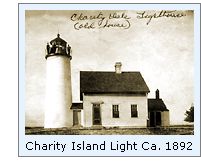
Construction on the island began in
1856, and continued into the following year. Colin Graham was appointed as
the station's first keeper on May 26, 1857, and exhibited the light
for the first time on an unrecorded date soon after his arrival.
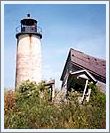
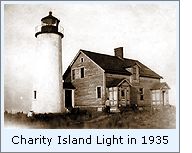
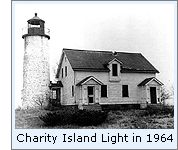 The 39-foot tall brick tower was capped by an octagonal cast iron
lantern displaying a fixed white
Fourth Order Fresnel lens. The tower's location on a slight rise
at the northwest point of the island placed the lens at a 45-foot focal
plane providing a 13-mile range of visibility, serving not only to warn mariners of the shoals around the island,
but as a link in the chain of coast lights the Board was
constructing along the western coast of the lake. The 39-foot tall brick tower was capped by an octagonal cast iron
lantern displaying a fixed white
Fourth Order Fresnel lens. The tower's location on a slight rise
at the northwest point of the island placed the lens at a 45-foot focal
plane providing a 13-mile range of visibility, serving not only to warn mariners of the shoals around the island,
but as a link in the chain of coast lights the Board was
constructing along the western coast of the lake.
By virtue of its exposed location, the
station was in a state of constant repair. By 1868 the infiltration of
the elements necessitated a major re-plastering of the walls and ceiling
and the complete replacement of the kitchen floor.
 In
1907 the station was one of the earliest on the Great Lakes to
be converted to the new acetylene illuminant system with the
installation of an 800-candlepower acetylene lamp within the Fourth Order Fresnel.
At this time the light's signature was also changed to exhibit a fixed
white light varied by a flash every ten seconds to better distinguish
the station. With continued improvements to the acetylene system over the
ensuing years, the Charity Island Light was completely automated in 1916, when
the station's last keeper Joseph Singleton boarded-up the building and
transferred elsewhere. Thus closed, the station required only infrequent service and
deliveries of acetylene gas by the crew of the Lighthouse Service
tender. The entire island with the exception of a small area of land
surrounding the tower was sold to the R.L Gillingham Fishing Company in
1926 who used the dwelling as a cottage and as temporary housing for
fishermen in the employ of the company. In
1907 the station was one of the earliest on the Great Lakes to
be converted to the new acetylene illuminant system with the
installation of an 800-candlepower acetylene lamp within the Fourth Order Fresnel.
At this time the light's signature was also changed to exhibit a fixed
white light varied by a flash every ten seconds to better distinguish
the station. With continued improvements to the acetylene system over the
ensuing years, the Charity Island Light was completely automated in 1916, when
the station's last keeper Joseph Singleton boarded-up the building and
transferred elsewhere. Thus closed, the station required only infrequent service and
deliveries of acetylene gas by the crew of the Lighthouse Service
tender. The entire island with the exception of a small area of land
surrounding the tower was sold to the R.L Gillingham Fishing Company in
1926 who used the dwelling as a cottage and as temporary housing for
fishermen in the employ of the company.
 In 1939, the Charity Island station was
deemed obsolete with the construction of the
"state-of-the-art" offshore light at Gravelly Shoal,
and the the
station deactivated and abandoned by the Coast Guard. Without any
maintenance the station's structures
began to deteriorate
rapidly. In 1939, the Charity Island station was
deemed obsolete with the construction of the
"state-of-the-art" offshore light at Gravelly Shoal,
and the the
station deactivated and abandoned by the Coast Guard. Without any
maintenance the station's structures
began to deteriorate
rapidly.
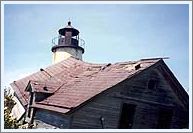
The island was again sold a development
group in the 1960s. Various schemes for development of the island, along with
rumors of various non-profit groups planning on restoring the light
station have come and gone, and after the complete collapse of the
original dwelling, it was torn down and replaced by the current owner
with an historically inappropriate modern Cape Cod style cottage.
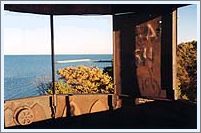
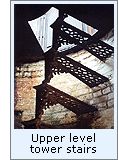
While the brick tower
remains in marginal condition,
it appears as though it might still be restorable, and many visitors
climb the tower for a commanding view of both the east and west
shoreline and most of Saginaw Bay.

Keepers of
this Light
Click here
to see a complete listing of all Charity Island Light keepers compiled
by Phyllis L. Tag of Great Lakes Lighthouse Research.
Reference sources
Lieut. James T. Homans 1838 report on lights to the Fifth Auditor of the
Treasury.
Lighthouse Board Annual Reports, 1855 through 1908.
Great Lake Light Lists, 1876 & 1920.
Thompson's Coast Pilot, 1869.
Scott's Coast Pilot, 1909.
Email from Joann Gulau of CIPC, 06/25/03
Keeper listings for this light appear courtesy of Tom & Phyllis Tag
|