The aqueduct trunks are all formed of timber. The abutments for the Bull Creek and
Flint Creek aqueducts are of hammer dressed masonry. Those of Aboite, Spy Run, and Becky
run, are built of timber. Flint Creek aqueduct rests on a solid rock bottom. All other
aqueducts are built on sand or gravel bottom, but are made secure by a platform of hewn
timber extending over the whole space between the abutments as well as under them The aqueduct trunks are all formed of timber. The abutments for the Bull Creek and
Flint Creek aqueducts are of hammer dressed masonry. Those of Aboite, Spy Run, and Becky
run, are built of timber. Flint Creek aqueduct rests on a solid rock bottom. All other
aqueducts are built on sand or gravel bottom, but are made secure by a platform of hewn
timber extending over the whole space between the abutments as well as under them
Jesse Williams - Chief Engineers Report to the Canal
Commissioners of 1833

Also, the building
of the stone work for a new aqueduct across the river Aboite, ten miles west of Fort
Wayne. The stone .... are to be obtained at the Lagro or Georgetown quarries. At the
aqueduct at the river Aboite the space is intended to be increased in width; that of the
one now in use has this last season proved insufficient for the water to pass at times.
The superstructure will be an open truck - the worth not being at this time deemed of
sufficient magnitude to cover the trunk.
Jesse Williams - Chief Engineers Report to the Canal
Commissioners of 1844
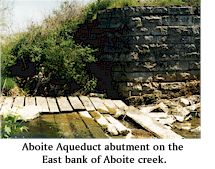 Aqueduct No. 2 over the trunk of Aboite, of four spans, each 28 feet clear. The
trunk is of wood resting on two abutments and three piers, all of good cut stone masonry.
This structure is entirely new, having been rebuilt in 1846, and will probably require but
little expense for 8 or 10 years to come. Aqueduct No. 2 over the trunk of Aboite, of four spans, each 28 feet clear. The
trunk is of wood resting on two abutments and three piers, all of good cut stone masonry.
This structure is entirely new, having been rebuilt in 1846, and will probably require but
little expense for 8 or 10 years to come.
Jesse Williams - Chief Engineers Report of 1847
The Aboite Creek
Aqueduct, which was built in 1833, and opened to traffic upon the opening of 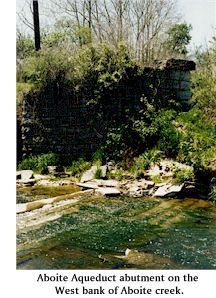 the first section of the W&E Canal 1n 1835 is
located in southwest Aboite township, downstream from the point at which US Highway 24
crosses the Aboite Creek. What remains today are the best ruins of a small open truck
aqueduct on the W&E Canal. the first section of the W&E Canal 1n 1835 is
located in southwest Aboite township, downstream from the point at which US Highway 24
crosses the Aboite Creek. What remains today are the best ruins of a small open truck
aqueduct on the W&E Canal.
This small aqueduct consisted of four spans as described
above. Timber was used for the piers and abutments due the absence of quality building
stone in the Wabash Valley. In 1848, the abutments were replaced with stone, as the
quarries to the west were opened-up.
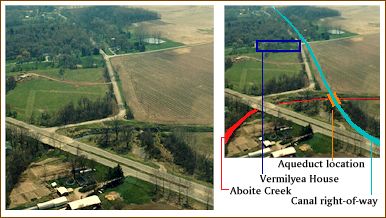
The site chosen for the aqueduct proved to be excellent. As
other forms of transportation developed in later years, their engineers too chose to cross
the Aboite at the same site. Today, five bridges can be seen within fifty meters of the
aqueduct's location. These bridges were constructed for the Huntington State Road, two
interurban lines, the old W.S. 24 highway, and today's four lane bridge.
|