|
|
  Freedom L. Cain never was a boat captain to
my knowledge, but was a steersman; he always stood at the tiller and steered the boat. His
last connection with canal boats was when he, and I think, Mr. James Wilhelm owned a boat
in partnership the H.S. Walbridge.
Huntington Herald, Sat. July 7, 1928 Letter to J. Bippus
from M. Hawley
Thomas
McConnell was among the early canal boatmen who came here from Pennsylvania. Those who
knew him well asserted that Captain McConnell never allowed his vocation as a boatman to
harden his heart or cause him to deteriorate beneath the plane of a gentleman who was
always loyal to his friends, and honorable in his transactions. For some time, he owned
and operated a fine boat known as the Pocahontas, built by Charles Thorn at his boatyard
in Huntington. On this boat he transported from this city to Toledo as high as 26,000 feet
of walnut timber at a single shipment. When the canal was about to go down, Captain
McConnell took the Pocahontas over to Ohio and sold her for a song to be used on the Miami
canal. He then purchased a farm west of the Zahm School house and just west of the Clear
Creek stream, where he undertook to clear-off some of the timber, which was labor he was
not accustomed to performing, and in his zeal to succeed, overtaxed his death resulting
prematurely. Freedom L. Cain never was a boat captain to
my knowledge, but was a steersman; he always stood at the tiller and steered the boat. His
last connection with canal boats was when he, and I think, Mr. James Wilhelm owned a boat
in partnership the H.S. Walbridge.
Huntington Herald, Sat. July 7, 1928 Letter to J. Bippus
from M. Hawley
Thomas
McConnell was among the early canal boatmen who came here from Pennsylvania. Those who
knew him well asserted that Captain McConnell never allowed his vocation as a boatman to
harden his heart or cause him to deteriorate beneath the plane of a gentleman who was
always loyal to his friends, and honorable in his transactions. For some time, he owned
and operated a fine boat known as the Pocahontas, built by Charles Thorn at his boatyard
in Huntington. On this boat he transported from this city to Toledo as high as 26,000 feet
of walnut timber at a single shipment. When the canal was about to go down, Captain
McConnell took the Pocahontas over to Ohio and sold her for a song to be used on the Miami
canal. He then purchased a farm west of the Zahm School house and just west of the Clear
Creek stream, where he undertook to clear-off some of the timber, which was labor he was
not accustomed to performing, and in his zeal to succeed, overtaxed his death resulting
prematurely.
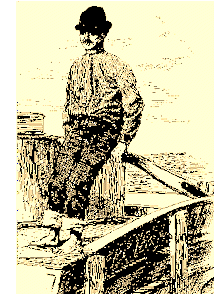 Captain McConnel's widow became the wife of Captain Patrick
Cunningham, for years a resident of Mahon, and in the days of canal traffic had charge of
the "State Boat", the crew of which attended canal repairs, dredging, etc."
Huntington Press, Friday August 3, 1928 (VM Collection)
Captain F. Cook was the skipper of the J.Q.Adams, built in Pittsburgh, the West
End built in Roanoke and the Magnolia, the second steam craft to operate on the
Wabash & Erie. There were 5 steamboats operating on the Wabash & Erie by the
end.......Ordinarily, leaving Delphi one morning, we could reach Logansport he next, Peru
the next, Wabash or Lagro the next, Roanoke the next, and pass Fort Wayne on the next. We
operated 7-8 months out of the year.
Huntington Herald Fri. Sept. 26, 1902
Samuel
Mahon was a polished and courteous captain of a canal packet, and with his brothers was
interested in the founding of the village of Mahon, on the canal a couple of miles South
of Roanoke, in Jackson township.
Huntington Herald Press, Aug. 7, 1925 Mahon & Packet
had endorsement. Captain McConnel's widow became the wife of Captain Patrick
Cunningham, for years a resident of Mahon, and in the days of canal traffic had charge of
the "State Boat", the crew of which attended canal repairs, dredging, etc."
Huntington Press, Friday August 3, 1928 (VM Collection)
Captain F. Cook was the skipper of the J.Q.Adams, built in Pittsburgh, the West
End built in Roanoke and the Magnolia, the second steam craft to operate on the
Wabash & Erie. There were 5 steamboats operating on the Wabash & Erie by the
end.......Ordinarily, leaving Delphi one morning, we could reach Logansport he next, Peru
the next, Wabash or Lagro the next, Roanoke the next, and pass Fort Wayne on the next. We
operated 7-8 months out of the year.
Huntington Herald Fri. Sept. 26, 1902
Samuel
Mahon was a polished and courteous captain of a canal packet, and with his brothers was
interested in the founding of the village of Mahon, on the canal a couple of miles South
of Roanoke, in Jackson township.
Huntington Herald Press, Aug. 7, 1925 Mahon & Packet
had endorsement. The1850
Huntington County Indiana Census lists the
following individuals with canal-related occupations.
Name
|
Age |
Occupation |
Origin |
Samuel Morgan
|
21 |
Boatman |
New York |
Charles Deavenport
|
27 |
Boatman |
New York |
James Deavanport
|
23 |
Boatman |
New York |
John E. Mahon
|
19 |
Boatman |
New York |
Joseph Lee
|
19 |
Boatman |
Ohio |
Robert Crandall
|
17 |
Teamster |
Ohio |
James Casgrove
|
44 |
Locktender |
New York |
Samuel L. Johnson
|
43 |
Boatman |
Vermont |
William Sealey
|
25 |
Boatman |
New York |
Charles Sealey
|
22 |
Boatman |
New York |
Jacob Holland
|
22 |
Boatman |
New York |
Alexander McGuin
|
34 |
Boatman |
Ireland |
Commanders were exalted beings. Preserving a
dignity proper to an eminence rating the princely wage of $50 a month or more, they had
the prestige of the master of a transatlantic liner.
Captain Arch Mahon of the "Noble", Captain Swinney of the
"St. Mary's", and Captain Young of the "Lafayette" were known to press
and public as kind, generous and accommodating. Captain Van Ness was the gentlemanly
skipper of the "Missouri," one of eleven packets operated by the enterprising
firm of Dickey, Doyle & Dickey - From Lafayette to Toledo in sixty hours.
Indiana Canals. Paul Fatout. Purdue University Press
1972
One
of the mule drivers was John Henry Warner of Roanoke.
Huntington Herald, Feb. 14, 1914 Reminiscences by Isaac
Brumbaugh. (VM Collection)
Last
night just after I had retired we reached a village, and pretty soon after the boat had
stopped I heard loud talking and swearing. More and more voices joined in, a good many of
them unmistakably Hibernian. Then there were cries and shouts, a gun or a pistol shot off,
then a pandemonium. Before I fairly knew what I was about I had put on some of my clothes
and clambered to the boats' top.
A terrible fight was going on at the wharf. There were twenty or thirty
drunken men, laborers on some public work, and they were fighting, the Irish against the
Americans. It was dreadful. Somehow, our captain got into this melee, and today has his
head tied up and his cheek patched. They would not let our boat go, but kept us there
until near two o'clock. Some officers came about eleven, but they were driven away with
clubs and stones. Tom stood by me with his gun ready, but no one came up where we were. I
never was so terribly frightened.
How we got away at last I cannot say. The officers did not come back, and
the men quarreled and swore and fought all the time. You may be sure I was glad when the
boat began to move along. What seemed terrible to me was that there were women all mixed
up in the row, and they swore horribly!
Stories of Indiana. Thompson. p 220 "Extract from a
private letter written 1851.
|