Races were frequent between the boats.
"One time we raced a boat all the way to Toledo, and beat them one hour." said
Crandal. "At night we could see their headlight back of us. When they got too close
we got in their swale and rested our horses and made theirs pull harder. Then they would
drop back a little and we would go on. You could ride the swale of another boat and
lighten the work for your mules. The boat behind you would push the water ahead, and the
boat in front would be in the way of the wave made by the boat behind it. If the boat in
front could get just far enough ahead to get at the beginning of this wave, the front boat
would be pushed along by the wave so that it would be easy pulling for the horses!" Races were frequent between the boats.
"One time we raced a boat all the way to Toledo, and beat them one hour." said
Crandal. "At night we could see their headlight back of us. When they got too close
we got in their swale and rested our horses and made theirs pull harder. Then they would
drop back a little and we would go on. You could ride the swale of another boat and
lighten the work for your mules. The boat behind you would push the water ahead, and the
boat in front would be in the way of the wave made by the boat behind it. If the boat in
front could get just far enough ahead to get at the beginning of this wave, the front boat
would be pushed along by the wave so that it would be easy pulling for the horses!"
The Huntington Press, Sunday Oct. 16, 1921 - Interview
with A.A. Crandal
Soon after leaving Logansport we found
the current in the canal quite rapid, and it being against us rendered our progress very
slow. This was the more vexatious, from the fact that there was a boat but a few rods
behind us that was struggling hard to run by, and another boat a few yards in advance,
being, as well as the one in the rear, of much lighter draft than our boat, which we were
struggling as hard to outstrip. We did not succeed in getting by the boat in advance -
owing to some necessary detentions - but we had some source of gratification in the fact
that the one in the rear couldn't come it.
Through Indiana by Stage Coach & Canal Boat Indiana
Mag. of History. LXXXV, 1989

When the water
was low, or the boats tied up because of a bar, the crew often went fishing. This was not
a very serious undertaking. They simply baited lines and fished from the boat. Many a time
they caught good strings of bullhead catfish from the canal.
Huntington Press Sunday Oct. 16, 1921 Interview with
A.A. Crandal.
Today is
Sunday, and the people all seem to be fishing in the canal. We have passed hundreds of
them sitting on the banks with poles in their hands and dangling their fish hooks in the
water; but I have seen no fish caught. The boatmen sauce them, and they retort pretty
roughly sometimes.
Stories of Indiana. Thompson. p 221 "Extract from a
private letter written 1851.
GREAT
TIMES among the FISHERMEN. Last week the water was drawn off the canal at this place, and
immediately thereafter every seine and dip-net was brought into requisition and crowds of
men and boys were seen scattered along the course of "the raging canawl," busily
engaged in taking out the unfortunate fish who chose to remain in their muddy homes
instead of rushing out with the water into the river. They were dipped up, picked up,
seined up (and ate up we presume,) in vast quantities. Every square foot of mud seemed to
be alive with the finny tribes who were taken out with little or no trouble. We observed a
barrel of fish at one draw, and what is more wonderful still, they were already dresses,
salted, and barreled up. They were genuine lake fish.
Wabash Weekly Gazette - March 15, 1854

The canal boat
Brooklyn, which was caught down about Col. Milligan's last season, passed here last week,
trying to make her way east to navigable water. It was a "tight fit", and she
has abundant opportunity to become intimately acquainted with the bottom of the canal. We
understand that there are still about a dozen boats west of this point, and it is doubtful
if they will ever get out of the canal.
Indiana Herald Wed. May 26, 1875
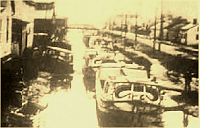 If the water happened to be low, two boats in passing
would get stuck fast in the mud, holding up all other boats, both coming and going, the
very air blue with the gentle remarks of the boatmen. If the water happened to be low, two boats in passing
would get stuck fast in the mud, holding up all other boats, both coming and going, the
very air blue with the gentle remarks of the boatmen.
Huntington Herald, Sat. July 7, 1928 Letter to J. Bippus
from M. Hawley
We regret to say exceedingly that it is very
uncertain whether we shall be able to issue more than an extra week. We have the promise
of a supply of paper by the first boat; but that boat is not yet arrived, and when it will
we know not. We learn that the canal between Huntington and Lagro is destitute of water,
and that there is not enough in the Wabash to fill it.
Fort Wayne Times and Peoples Press. August 1845
I looked
around, on reaching the door when lo, and behold! instead of moving on toward Maumee City,
we were fast, yes actually fast on a log! The captain was talking very fast, and very loud
- the men were running this way and that in the utmost confusion, and all seemed to be
impressed with the idea that the more noise they made, the more easily they would get
free. By dint of loud talking, and jabbering and swearing, and hallooing, and pushing with
their long poles, and pulling and running and whipping up the horses, they did, after two
hours, succeed in getting off. I soon returned to my shelf, and amid all the bustle and
confusion went to sleep, and slept soundly until five o'clock next morning.
Through Indiana by Stage Coach & Canal Boat Indiana
Mag. of History. LXXXV, 1989
It was true
that a canal boat was occasionally halted by a sunken stump or rock, or reposed for an
hour or two on a mud bank.
The History of Travel in America. Seymour Dumbar. 1915
I crawled out,
and poking my head out of the cabin door found that, sure enough, we were making no
progress. I learned upon inquiry that we had been in that fix since two o'clock, and were
likely to remain so for three or four hours more. This, certainly was not very pleasant,
especially as we were anxious to get on.
The cause of
our delay was that the gates of the lock where we were, had been opened in the night and
permitted to remain so; while those in the lock above remained closed. The consequences of
this mismanagement were that the water was drawn off the level above us, between the two
locks, and it was impossible for us to proceed until the water could be let in at the
upper lock and fill the level again.
A boy had been sent up to open the gates of the lock above, and the water
was already rising. In about two hours the boat floated again, but we proceeded very
slowly; the boat rubbing against the bottom, every few rods, and sometimes stopping
entirely, where we were forced to remain until the rising water floated us off.
Through Indiana by Stage Coach & Canal Boat Indiana
Mag. of History. LXXXV, 1989
Mr. Alschwede
recalled the last boat on the canal. It was owned by Max Baumgartner who started a trip
west. The canal was low at the time and Baumgartner and the boat stalled just east of the
old red bridge that spanned the river on the Range Line Road. There the old boat laid and
rotted, Alschwede said. Numerous fishermen helped the boat disappear by using the wood for
fires.
Huntington Herald Press August 22, 1948 (VM Collection)

A break
occurred at one of the locks on the canal near this place on Friday of last week. We are
told that near 200 boats were delayed here, and as a matter of course, our town has been
the theater of a great deal of disgraceful conduct. The beauties of liquor selling and
drunkard making have been fully demonstrated. Citizens, how do you like them? Do we need a
prohibitory law?
Indiana Herald, Nov. 15, 1854 p2 col. 1
We find the
following notice of the repairs of the feeder dam near Fort Wayne in the Sentinel of that
place: The repairs of the breach at the feeder dam are progressing rapidly and favorably.
A dam of brush and crib work is already completed across the break, and the water
effectually turned into its' proper channel. An earth guard bank will be made above the
dam in a few days. The work is considered entirely safe, and the canal will be opened by
the 10th or 15th of April.
Indiana Herald. April 1, 1857. p2 col 3
In many places
throughout the lowlands the canal was built up instead of being excavated. That is, it ran
between stretches of levees or dikes and the springing of a leak through these not
infrequently resulted in a washout which would empty the ditch, leaving boats, freight and
passengers stranded in the mud until the breach was repaired and the canal re-filled.
Floods had their dangers, and in 1844 the liberated contents of a mill-dam
broke through adjacent levees so swiftly that a packet boat, the Kentucky, was carried
bodily through the gap into the river bottom and broken to pieces among the trees, three
passengers being drowned.
Centennial History and Handbook of Indiana. Cottman.
1915. p 115
Trouble was
continual. Elusive water seeped out of minute fissures that, if not plugged, were likely
to become wide breaches. Freezing and thawing shifted the mobile earth; burrowing muskrats
and crawfish aided the water to escape. Given an opening the canal crumbled its banks, and
it could be murderous. The Packet Kentucky, caught by the swift current boiling through a
big break near Logansport, snapped her mooring lines and sailed helplessly out into the
woods, where she crashed bow against a tree, swung around, hit another with her stern,
broke in two and spilled passengers into the flood. Three men were drowned.
Indiana Canals. Paul Fatout. Purdue University Press
1972
A canal meeting
was held at Lafayette on Friday last, which was represented by employees and mill owners
and warehouse men. The delegates from this place were Capt. P. O'Brien and Wilson Smith. A
resolution was adopted that "no officer of the Canal Company shall have power to
incur any expense, or create any liability, not now existing by reason of which the debts
or liabilities of the Company may be increased". It was estimated that the damages to
the canal from the late flood were about $10,000, and that $4,500 would repair the canal
from Wabash to the Ohio state line, barring the ordinary expense and necessary repairs
that will have to be made this spring.
The Huntington Democrat, May 1, 1873
Our merchants
are subjected to great inconvenience and loss this Spring, in consequence of the break in
the Miami Canal, one mile and a half below the Junction. According to reports which have
reached us, there is no probability of the break being repaired this side of July. In the
meantime the supplies of Groceries, &c., which were purchased at Cincinnati, are
detained, and in fact, many of them are in such a condition that cannot be got at. At this
time Groceries are very scarce in this place; and unless supplies are obtained elsewhere,
a few days will exhaust the stock. As at present managed, Canals are a nuisance, and the
sooner they are abated the better it will be for business men generally.
Indiana Herald. May 23, 1855. p2 col 2
That year
(1874), the last boat on the canal east of Lafayette was crossing the Deer Creek aqueduct
when the decrepit structure gave way, and the mules and black driver were swept down the
roaring water into the creek below and drowned.
Old Towpaths. Alvin F, Harlow 1926 D. Appleton Co.
Accident.-A negro boat driver belonging to the Canal boat
"Key Stone State," was brought here on the boat, dead, on Thursday last under
the following circumstances: While crossing the Deer Creek bridge himself and team fell
through the bridge. One of the mules of the team was drowned, and when the driver was got
out he was to all appearance dead. The captain used every means for his resuscitation, and
at length succeeded; when the boat reached Delphi a physician was called who administered
some medicine, after which the boy grew worse until he died, which happened between this
and Logansport. The Captain had the deceased decently buried.-Peru Sent.
Delphi Journal, June 22, 1858

No more
delightful experience of travel could be obtained in all the country than that encountered
by a canal boat passenger while moving through a region of wooded hills during the hours
of a moonlit summer night. Ahead he could see the plodding horses and their driver. The
lights from the open windows gleamed on the towpath and the rugged hillsides, and each new
turn of the waterway brought into vision some new scene of shadowy loveliness. From the
cabins beneath came the sound of laughter and children's voices, and if by chance he
embarked on a canal boat that had an organ, he heard the strains produced by its
manipulation, accompanied by rollicking choruses from a score of voices in which he
himself no doubt also joined.
The History of Travel in America. Seymour Dunbar. 1915
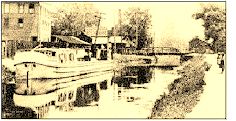 It has been a dreadfully hot day, but a good wind is blowing from the
Northwest, and just now it is getting cooler as the sun is going behind the clouds in the
west. We have passed through some lovely country, where rich farms, like those in some
parts of Tennessee, stretch away as far as you can look. On our left, a short distance
away, the Wabash River has been in sight most of the time, and beyond it large fields of
bottom land waving with luxuriant young corn. On our right, the farms are ore rolling in
places, but fertile and well kept; only the houses are miserable looking. I have not seen
a single homelike farmhouse for a hundred miles, it seems to me. It has been a dreadfully hot day, but a good wind is blowing from the
Northwest, and just now it is getting cooler as the sun is going behind the clouds in the
west. We have passed through some lovely country, where rich farms, like those in some
parts of Tennessee, stretch away as far as you can look. On our left, a short distance
away, the Wabash River has been in sight most of the time, and beyond it large fields of
bottom land waving with luxuriant young corn. On our right, the farms are ore rolling in
places, but fertile and well kept; only the houses are miserable looking. I have not seen
a single homelike farmhouse for a hundred miles, it seems to me.
The little towns along the canal are forlorn-looking places; but they seem
to be doing business. Tom says that some of the men are getting rich. I do not see the
evidence of it if they are. Such houses as they live in are advertisements of hopeless
'greenhorn' existence. Our kitchens are far better than their drawing rooms. Tom and I
went out into one village where the boat remained two hours and a half, and I got into the
best-looking house in the place by asking for a drink of water. Things were worse inside
than out. There was a bed in one corner of the parlor, and no carpet on the floor. Five
little dirty children came in to gaze at me. They all seemed to be of the same age. One
fat, big eyed chap, a boy I think, but they were all dressed alike in calico slips, came
up close to me. I wanted to hug him because he was saucy-looking, and I wanted to spank
him for not keeping his nose clean. I concluded to do neither.
Stories of Indiana. Thompson. p 220 "Extract from a
private letter written 1851.
We passed
through a great deal of beautiful country. Through scores and scores of miles of woodland
that had never seen an ax; past thousands of acres where the trees were rotting in the
steaming pools collected about them. For the canal sometimes passed along the slope of a
rising ground, where the water wept thorough the bank on the lower side; for, whatever
hollows were to be passed over. its channel was not formed by being dug out of the earth,
but by the piling of earth on each side to form embankments. These were often broken
violently away; and the water, let in through upper locks, truckled over them and formed
morasses on each side.
A country that might otherwise been healthy, was thus changed into a swamp
by this canal; and immense labors of drainage would be required before it could be
rendered habitable, owing to the floods thus artificially produced. But who thought of
inhabiting the region when the canal was made? The land was then a worthless desert, and
the one thing needed was to get through it.
The Wabash, Adventures of an English Gentleman's Family
in Indiana. J. Richard Beste. 1855
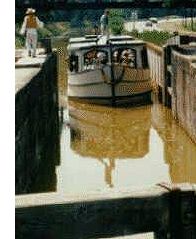 About four o'clock in the morning we were all aroused
by a tremendous racket on, and about the boat, and we all, simultaneously, jumped from our
berths and rushed up on deck, to learn what all the outcry could mean. The cry, "the
horses are in the canal" made known the cause of the uproar, and on looking ahead we
saw that, sure enough, one of the horses and the driver were in the water - which at this
place, just below a lock, is very deep and the current swift - and both swimming toward
the shore for dear life. About four o'clock in the morning we were all aroused
by a tremendous racket on, and about the boat, and we all, simultaneously, jumped from our
berths and rushed up on deck, to learn what all the outcry could mean. The cry, "the
horses are in the canal" made known the cause of the uproar, and on looking ahead we
saw that, sure enough, one of the horses and the driver were in the water - which at this
place, just below a lock, is very deep and the current swift - and both swimming toward
the shore for dear life.
They soon got out, without any serious injury, and the driver getting on a
dry suit of clothes, we went on as usual. The cause of this disaster we learned to be,
that they had endeavored to cross a bridge, without unfastening the tow line, (the manner
in which they usually cross bridges on this canal,) and the current being very rapid, had
not only stopped the head way of the boat, but began to carry it down stream. The tow line
remaining still attached to the boat, drew our horse, with the driver on his back, over
the railing into the water. The other horse, by a desperate effort, succeeded in braking
loose, and saved himself from a ducking.
The distance from the bridge to the water was, at least, ten feet, but as
the water was very deep, neither the horse, or the drive experienced any other injury than
a good wetting.
Through Indiana by Stage Coach & Canal Boat
Indiana Mag. of History. LXXXV, 1989
Another time we were going through a lock, and the boat was way below the
path. Dad was trying to work one of the mules around, and it got stubborn.
My father was a powerful man, and when he got tired of trying to make the
mule go, he hauled of and hit it with his fist, and knocked it down. It was right on the
edge of the path, and I thought it would slip in the lock. If it had, it would have
smashed the deck of the boat. Dad saw what had to be done right away, and he grabbed the
mule around the neck and drug it away from the lock. The mule would have weighed 1,100
pounds.
The Huntington Press. October 16, 1921. Interview with
A.A. Crandal
The
price of five cents a mile was early established, and for a time formed the basis of an
ingenious scheme that was frequently used by pedestrian travelers who were following the
route of a canal. Such a man based his plan on the knowledge that a packet moved at the
rate of about a mile in twenty minutes, and that meals aboard a boat were served at
The History of Travel in America. Seymour Dunbar. 1915
One time in
summer, we met with a storm. We never stopped for anything until the ice stopped us, and
we went right through storms. A flash of lightning hit a black elm right near the mules.
It was hard work, and we were using both teams at the time. Well, the six mules dropped
down to the ground as if they ware all dead. I was riding one mule and I felt the
electricity, but it did not hurt me. Then the mules began to open their eyes and in a
minute every one of them was on their feet again. I wasn't afraid of the lightning that
hit the tree and the mules, but I kept watching for another flash, believe me."
The Huntington Press. October 16, 1921. Interview with
A.A. Crandal

Meeting another
boat was a mild adventure. The rules of the road gave the right of way to an upstream
craft, the downstream boat slackening its tow line so that the other sailed over it as the
two passed port side to port side, each hugging the starboard bank, for the narrow channel
did not allow much open water between. People on both waved at each other and fluttered
handkerchiefs, as if on ships passing close at sea.
Indiana Canals. Paul Fatout. Purdue University Press
1972
Passenger packets are given the right of way. If we come up to a slower boat the
bowsman let out some of the extra rope so we can pass, our boat going over their line of
rope.
A trip on the Wabash & Erie Canal. Marilyn S.
Steele. (Undated)

Swimming too was
afforded the boys. One aging man told of his fun going in the canal saying "The size
and rapidity of the ripples in advance of a coming boat around a bend warned them of its
kind, a freight or passenger carrying boat. The freight boat came slowly, making broad
ripples and we did not hurry out, but crawled on the bank just in time to let it go by,
but a boat that carried passengers came faster, sometimes with horses trotting, making
little choppy ripples and many more of them and was fair warning to us that it was time to
get out at once and put on some clothes.
History of the W&E. Dr. Ross Lockridge. Unidentified
article - Indiana room, Huntington Library
One time we
were going down the Maumee, I bantered my captain to get hold of a tow rope and drop in
behind for a swim. We both stripped, got a rope apiece and jumped in. We had to hold tight
to the rope, for the tug was taking us along at a merry clip, and if we let it go we would
be a mile from shore. I would work over to him and put my foot on his rope and you might
ought to have heard him beg. Every time I put my weight on his rope, his head would go
under and the tug would drag him along under water until I got my foot off. When we had
our swim we went up the side of the boat hand-over-hand.
Huntington Press. Sunday Oct 16, 1921. Interview with
A.A. Crandal.
|