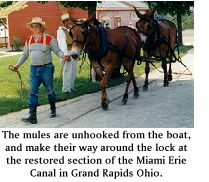
  The
number of horses or mules, from two to six, employed in drawing the packet depended on its
size. The animals traveled at a trot, the driver riding on the left rear steed, and a pace
of two to eight miles per hour was maintained. Sometimes relay horses were carried on the
freight boats, but usually the horses were stationed at regular intervals or convenient
posts about ten miles apart. One company, Doyle's packet Line, operated fifteen boats and
owned three hundred and fifty two tow horses. The boats were drawn by a 3 inch hemp rope
150 to 250 feet long. The
number of horses or mules, from two to six, employed in drawing the packet depended on its
size. The animals traveled at a trot, the driver riding on the left rear steed, and a pace
of two to eight miles per hour was maintained. Sometimes relay horses were carried on the
freight boats, but usually the horses were stationed at regular intervals or convenient
posts about ten miles apart. One company, Doyle's packet Line, operated fifteen boats and
owned three hundred and fifty two tow horses. The boats were drawn by a 3 inch hemp rope
150 to 250 feet long.
Fort Wayne on the old Canal. FW & AC Public library,
1952
But a boat that
carried passengers came faster, sometimes with horses trotting.
History of the W&E. Dr. Ross Lockridge. Unidentified
article - Indiana room, Huntington Library
I remember we
stopped at the Vermilyea hotel for dinner. They changed horses there.
Huntington Herald, Jan. 3, 1896 Grandmother Hawley rode
in it 60 years ago.
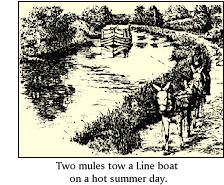 Talk about your Pullman packets, they had them in those days, but they were pulled
by mules. Talk about your Pullman packets, they had them in those days, but they were pulled
by mules.
Reminiscences of old Fort Wayne. Lura Woodsworth et al..
A canal
packet....was pulled by a better breed of live stock, charged one or two cents a mile more
for its tickets, and progressed at the rate of three or three and a half miles an hour. If
a line boat and a packet left a given point simultaneously, at the end of twenty-four
hours the lucky passengers on the packet boat would find themselves about twenty-four
miles ahead of their less fortunate fellow travelers. After a week of steady travel they
would probably be more than a hundred and fifty miles ahead.
The history of Travel in America. Seymour Dunbar. 1915.
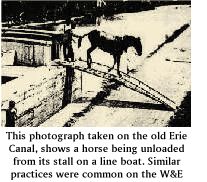 The
third variety was the packet boats for travelers. These moved at a fair rate of speed as
the horses traveled on the trot at all times and were changed at frequent intervals. These
boats usually traveled at night, so you see that in twenty four hours the traveler covered
quite a distance. The
third variety was the packet boats for travelers. These moved at a fair rate of speed as
the horses traveled on the trot at all times and were changed at frequent intervals. These
boats usually traveled at night, so you see that in twenty four hours the traveler covered
quite a distance.
Roanoke History Dr. S. Koontz. Roanoke Review, 1921
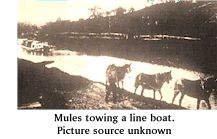 Three horses were harnessed to a rope, about fifty yards ahead of the boat; they
started at a moderate trot; and the town where we had tarried so long, was soon lost to
our sight. Three horses were harnessed to a rope, about fifty yards ahead of the boat; they
started at a moderate trot; and the town where we had tarried so long, was soon lost to
our sight.
The Wabash, Adventures of an English Gentleman's Family
in Indiana. J. Richard Beste. (Lucy writes) 1855
|