That part
of the general public which desired to use the canals was evidently divided into two
classes. One of these classes was composed of individuals or families who were removing
permanently from their familiar homes to new locations in the West, and to whom
time--measured in hours or days--was not of great importance.
 The other portion of the canal-patronizing public was made up of
travelers who really had a need to arrive at their destination within the shortest
possible period, and they demanded the swiftest progress that could be made. Persons such
as these were willing to pay an increased price for quick transportation, if necessary,
while the first-named class wanted to move ahead at the cheapest possible cost. The same
canal boat obviously was not an appropriate vehicle for carrying both these sorts of
people, and so was brought about a division of passenger boats into two types, one of
which became known as the line boat, and the other as the packet The other portion of the canal-patronizing public was made up of
travelers who really had a need to arrive at their destination within the shortest
possible period, and they demanded the swiftest progress that could be made. Persons such
as these were willing to pay an increased price for quick transportation, if necessary,
while the first-named class wanted to move ahead at the cheapest possible cost. The same
canal boat obviously was not an appropriate vehicle for carrying both these sorts of
people, and so was brought about a division of passenger boats into two types, one of
which became known as the line boat, and the other as the packet
The History of Travel in America. Seymour Dumbar. 1915
People
began to travel, not only because there was a growing class who could afford to, but
because the new passenger transportation by boat was a luxury compared with the travel by
coach over rough wilderness roads. Passenger packets, less bulky and more speedy than the
freight boats, appeared, and these, hauled at a sharp trot, could make, under favorable
conditions, about eight miles an hour.
Centennial History and Handbook of Indiana. Cottman,
1015. p 114
The first
canal boats were modeled after the keelboats or barges of river fame, and built with
pointed bow and stern, rounded bottoms and narrow beam; they were about 50 or 60 feet
long. Soon it was found that these features were not necessary in quiet waters, so a
blunt-ended, wider and flatter boat became standard.
The Old Northwest. Pioneer Period 1815-1840. Buley.
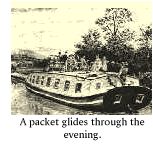
A packet,
gleaming white, trimmed with red, sailed in grandly. Three horses or mules, hitched to a
250 foot hawser of three inch hemp made fast to a cleat halfway between bow and amidships,
pulled the boat at a speed of four to eight miles an hour, fresh teams being taken on
every fifteen or twenty miles. Alert drivers who took pride in smart outfits,
industriously groomed their steeds, decorated manes and harnesses with rosettes, and
buffed-up leather and brass to a high polish. The Silver Bell, which carried a bell of
silver in the bow, had three silver-gray mules, each with bells on and harness
silver-mounted.
Indiana Canals. Paul Fatout. Purdue University Press
1972
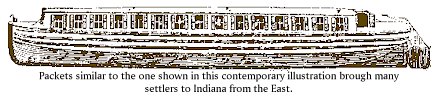
Bright
colors were not confined to Conestoga wagons and stagecoaches, for packet lines vied with
one another in the variety and elegance of the hues with which they decorated their boats
The Old Northwest. 1815 - 1840. Buley p.507
The compact
design was ingenious, though not spacious. A Wabash & Erie packet was a tight
microcosm 80 to 100 feet long, of twelve or sixteen foot beam. She was a miniature version
of the palatial river steamer, the interior thickly carpeted in splashy colors, lighted by
chandeliers of sparkling glass, woodwork of white filigree touched up with gilding.
Indiana Canals. Paul Fatout. Purdue University Press
1972

Besides a
captain. she carried a steward, cook, pantry man, chambermaid, two cabin boys, two
drivers, and two steersmen.
Indiana Canals. Paul Fatout. Purdue University Press
1972
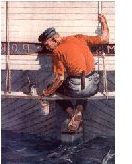 A typical
packet crew comprised the following: Captain, steward (who enjoyed all of the profits from
the bar), pantry man, cook, chambermaid, two cabin boys and two steersman. The crew of a
canal boat usually consisted of the captain, two steersmen, two drivers and the cook. A typical
packet crew comprised the following: Captain, steward (who enjoyed all of the profits from
the bar), pantry man, cook, chambermaid, two cabin boys and two steersman. The crew of a
canal boat usually consisted of the captain, two steersmen, two drivers and the cook.
The captain was on duty dawn until after the passengers
were in bed. The steersmen worked alternately throughout the twenty-four hours, and each
guided the craft for a period of six hours before relinquishing the helm to his alternate;
the two drivers worked in a like manner with the steersmen.
The cook worked all the time. The drivers were the most
humble members of the crew, and if one of them displayed unusual care in performing his
work, he was eventually promoted to the position of helmsman; a helmsman in a similar way
sometimes became a captain, provided the boat was operated by a company. In a case wherein
the boat was the property of an individual, the owner himself often acted as its captain.
A captain ordinarily received fifty or sixty dollars a
month, a steersman from thirty-five to fifty dollars a month, and a driver about twenty
dollars a month. All members of the crew were also supplied with their food and with such
lodging as the boat provided.
Fort Wayne on the old Canal. FW & AC Public library,
1952
The
captain, a very young man, was very civil and attentive to our wants: and told us that tea
would be served at seven
The Wabash, Adventures of an English Gentleman's Family
in Indiana. J. Richard Beste. (Lucy writes) 1855
The crew
was usually quartered in the forward part of the boat
Canals of Mid-America. Leslie C. Swanson, 1964. Moline
IL.
In its
internal arrangement, the packet also speedily assumed a standard pattern. In the bow was
a small covered cabin containing five or six bunks for the crew, and this part of the boat
was separated from the rest of the boat by a partition.
The History of Travel in America. Seymour Dumbar. 1915
The
captains cabin was in the bow, lesser members of the ships crew stowing away in cubbyholes
aft.
Indiana Canals. Paul Fatout. Purdue University Press
1972
Nearly all
of the space aft of the crew's cabin was devoted to the accommodation of the public, and
was divided into a number of compartments.
The History of Travel in America. Seymour Dumbar. 1915

The
lounging room was also used as the dining room, and at night, cots were installed to give
additional sleeping quarters.
Canals of Mid-America. Leslie C. Swanson, 1964. Moline
IL.
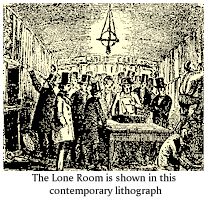 The center section of
some thirty-six feet was a long salon which served as a daytime parlor for all, plush
upholstered and cozy, if at times rather stuffy.... Without a stateroom to retreat to, the
traveler could not close his door, loosen his tie, take off his shoes, put his feet up and
momentarily forget about the stresses of social give and take. On a canal boat everybody
was continually in the company of almost everybody else. The center section of
some thirty-six feet was a long salon which served as a daytime parlor for all, plush
upholstered and cozy, if at times rather stuffy.... Without a stateroom to retreat to, the
traveler could not close his door, loosen his tie, take off his shoes, put his feet up and
momentarily forget about the stresses of social give and take. On a canal boat everybody
was continually in the company of almost everybody else.
Indiana Canals. Paul Fatout. Purdue University Press
1972
The largest
compartment of all immediately adjoined the women's quarters, and it was devoted to a
number of uses. This large room, usually about forty five feet in length served by day as
a place of general assembly, and on stormy passages was a spot in which men travelers
gathered for protection from the elements. Here they might write their letters, and here
also they could assemble to participate in those exciting games of checkers or backgammon
that served to dissipate the tedium of the voyage. Here they would gather for their
discussions regarding the political condition of the country or to sing their rollicking
choruses. Nearly all the hand baggage of the travelers likewise found its resting place in
this big room.
The History of Travel in America. Seymour Dumbar. 1915
With the
first indication of dawn the passengers emerged from the night's surroundings and sought
the open air. The men's washroom was so small as to be entirely inadequate for the use of
any considerable number of persons, and members of the crew or some of the travelers
themselves would, in consequence, lower buckets over the side of the boat and draw up
water for their ablutions. Such of the group as were particular about their personal
appearance, afterward formed a line to secure the massive comb and brush that were always
chained to the wall of the washroom.
The History of Travel in America. Seymour Dumbar. 1915

The first
of these was generally a washroom and dressing room women, and following it was the
women's cabin.
The History of Travel in America. Seymour Dumbar. 1915
The Ladies
retiring room, forward of the parlor, was a no mans land protected by a stout partition
that made the section off-limits for all gentlemen. The separation satisfied propriety,
but it did not mean much because nobody had any real privacy in the intimate life of a
packet.
Indiana Canals. Paul Fatout. Purdue University Press
1972
She
(the packet Albert S. White) is commodious, and her apartments so arranged as that there
can be no danger of indiscriminate mingling up of male and female passengers and crew, as
is sometimes necessarily the case in boats of bad construction"
Tippecanoe Journal & Lafayette Free Press. Sept. 15
1841
Adjoining
it (the lone room) was the ladies saloon; beyond which again, was a small cabin containing
only four berths. This cabin was separated by a doorway and curtain from the ladies
saloon, and on the other side opened upon the bow of the vessel. In it, was a looking
glass, a hand basin, two towels, a comb, and a brush, for the use of the ladies. It was a
rule in the boats that no gentlemen should go into the ladies' saloon without express
invitation from the ladies, consequently, the third little room was sacred to the female
sex unless entered from the bow, in which case a male occupant would cut off the ladies
from their wash house.
The Wabash, Adventures of an English Gentleman's Family
in Indiana. J. Richard Beste. 1855

The one
deck, flat or turtleback, served as baggage carrier and as theoretical promenade, but it
was too crowded to permit more than a few steps in any direction. Passengers sat on trunks
and benches or on the deck itself, feet hanging over the edge.
Indiana Canals. Paul Fatout. Purdue University Press
1972
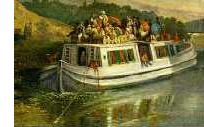 Early photographs of
the canal packets show that the roof was a favorite spot for canal passengers. If the
passengers tired of life on the boat, they would frequently alight at a lock and walk the
towpath back of the horses and mules until they came to the next stopping place. Early photographs of
the canal packets show that the roof was a favorite spot for canal passengers. If the
passengers tired of life on the boat, they would frequently alight at a lock and walk the
towpath back of the horses and mules until they came to the next stopping place.
The boats were frequently loaded with passengers far beyond
their capacity, and many guests were forced to sleep on the floor of the cabin, or on the
roof of the boats.
Canals of Mid-America. Leslie C. Swanson, 1964. Moline
IL.
Of pleasant
summer weather the travelers, lolling about the roomy decks of the smoothly gliding
packet, played games, conversed, sang in chorus or otherwise cultivated the social
amenities as it fitted their holiday mood. At the locks where the boats delayed, romantic
couples could stroll on ahead, if they wanted to, gathering wild flowers as they went.
Centennial History and Handbook of Indiana. Cottman,
1015. p 114
A flat roof
spread over the whole of the saloons; and on it was piled the luggage; and here passengers
walked up and down or sat to enjoy the view"
The Wabash, Adventures of an English Gentleman's Family
in Indiana. J. Richard Beste. (Lucy writes) 1855
The cabin
walls rose five or six feet above the hull, and the flat roof served as a promenade deck
for passengers during fair weather.
The Old Northwest. Pioneer Period 1815-1840. Buley.
At the cry
of "Low Bridge!" everybody ducked to avoid a sharp bang on the head when the
boat sailed under a span. Clearance was so low that travelers often jumped aboard from
bridges.
Indiana Canals. Paul Fatout. Purdue University Press
1972

As a packet
approached a landing, one of the crew sounded a horn. Villagers flocked to the canal to
see passengers and pick up news from neighboring and distant communities.
Fort Wayne on the old Canal. FW & AC Public library,
1952
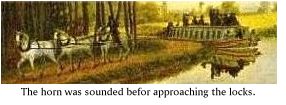 Charles
Kiser recounted "I can well remember when the packets used to run here on the Canal,
and I recall my great anxiety to have a chance to ride on one of them. They seemed grand
to us then. The packets had a bell on them and a tin horn. They would ring the bell coming
into the city. The lock and bridge tenders were notified of the coming of the boat by
means of the horn. Charles
Kiser recounted "I can well remember when the packets used to run here on the Canal,
and I recall my great anxiety to have a chance to ride on one of them. They seemed grand
to us then. The packets had a bell on them and a tin horn. They would ring the bell coming
into the city. The lock and bridge tenders were notified of the coming of the boat by
means of the horn.
Reminiscences of old Fort Wayne. Lura Woodsworth et al..
The
approach to a town was heralded by a great blowing of the boat's horn that brought out the
townsmen, and at the dock the two crowds, mingling, fraternized genially and exchanged
information till the boat's horn again gave warning of departure.
Centennial History and Handbook of Indiana. Cottman.
1915. p 114
|