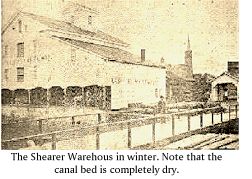
  The Shearer warehouse was built in 1853 on the north bank at the current location
of the Huntington theater. It cost $10,000, and was owned and operated by David L. Shearer
and his sons Frank, George and David until the Civil War years when was sold to George
James Wright. The Shearer warehouse was built in 1853 on the north bank at the current location
of the Huntington theater. It cost $10,000, and was owned and operated by David L. Shearer
and his sons Frank, George and David until the Civil War years when was sold to George
James Wright.
In 1902, the Shearer warehouse, along with the equipment, was sold to the
Wabash Railroad, and moved to the company's tracks at the location now occupied by the
Huntington County Farm Bureau near First and Court Streets.
Huntington Herald Press May 30, 1976 - Huntington
Heritage series. (VM Collection)
The Amazon was built for Jim Mulligan, who finally
sold it to Wilhelm. The Amazon won a $100 prize paid in Toledo for bringing-in the largest
cargo ever received in that port from a canal boat. The 2,600 bushels of wheat from D.L.
Shearer's warehouse which stood where the Huntington Theater is now located. We handled
that great boat with 6 immense mules, the best ones I ever knew in my life!
F. S. Bash article, March 29, 1931 Source unknown. (VM
Collection)
A fine selection of spring wagons at Shearers on the
canal. 5 percent cheaper than you can have them put up any place in the city. Call and see
for yourselves.
Indiana Herald, Wed. May 26, 1875
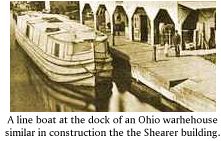 Agnes Humbert, a niece of Mrs. D.L. Shearer played in
the grain bins with her pal Harriet Davies. "Hattie and I would climb into the grain
bins as they were being emptied of contents through chutes to waiting canal boats below.
As the grain swirled forward, we waded through its depths, keeping back just far enough to
escape being hurled headlong down the chutes. Agnes Humbert, a niece of Mrs. D.L. Shearer played in
the grain bins with her pal Harriet Davies. "Hattie and I would climb into the grain
bins as they were being emptied of contents through chutes to waiting canal boats below.
As the grain swirled forward, we waded through its depths, keeping back just far enough to
escape being hurled headlong down the chutes.
Copy of 1939 article. Source unknown.
David L. Shearer, grain dealer and prominent
business man.....born in Prebble county, Ohio....at the age of eight years, was taken to
Tuscarawas County, Ohio, in the common schools of which he obtained the elements of a
practical education. When thirteen years old he accepted a clerkship in a mercantile house
at Shanesville, Ohio, where he remained until 1840, at which time he took service in the
same capacity in Huntington, Indiana, in which city he subsequently (1846) engaged in the
goods business on his own responsibility. He remained at Huntington
until 1866, at which point he disposed of his interests there, and came to Peru and
engaged in the grain business and financial profit ever since.
History of Miami County. 1887. p 466-467
|