The cost of
a ticket on a packet boat, which also included the price of meals and a sleeping bunk,
usually amounted to about five cents for a mile of distance traveled.
The History of Travel in America. Seymour Dumbar. 1915
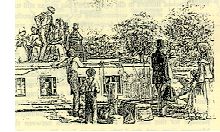 Cost of the passage
was cheap, averaging about 50 cents a day, or five cents per mile. Children were charged
much lower rates, and on some of the packet lines those under eight were carried free.
Meals were usually included in the price of the bigger packets, but on smaller boats,
without cooking facilities, passengers would stop at small towns or farm houses for food. Cost of the passage
was cheap, averaging about 50 cents a day, or five cents per mile. Children were charged
much lower rates, and on some of the packet lines those under eight were carried free.
Meals were usually included in the price of the bigger packets, but on smaller boats,
without cooking facilities, passengers would stop at small towns or farm houses for food.
Canals of Mid America. Leslie C. Swanson. Moline IL 1964
Fare on the
line boats was about 1 1/2 cents a mile, as against 3 of 4 cents on the packets
Old Towpaths. Alvin F, Harlow 1926 D. Appleton Co.
By 1844,
the packet boats maintained regular schedules between Fort Wayne and Toledo, a distance of
104 miles, and by 1847 this service had been extended to Lafayette.
Fort Wayne During The Canal Era. Charles R. Poinsatte
Ind. Hist. Review 1969
When passengers came aboard, they usually signed a register which
determined their rights to sleeping and eating
accommodations. Those who arrived late had to be prepared to sleep on the floor or deck.
Printed rules of conduct were usually displayed in conspicuous fashion to catch the eye of
the traveler at the outset of his journey. Some of the strictly enforced laws were as
follows:
No
gentleman could lie in bed with his boots on, and gentlemen were not allowed to go to the
table in their shirt sleeves.
Canals of Mid America. Leslie C. Swanson. Moline IL 1964
We went on
board, by way of a board, a gang-plank, that is, and soon found ourselves in a dark,
hole-like room, where it was hard to breathe and impossible to see plainly. There was a
queer smell, Tom says all canal boats have that odor. Of course, this being my first
experience, I cannot say how true it is.
Stories of Indiana. Thompson. p 218 "Extract from a
private letter written 1851.

Sleep or no
sleep, all were routed out early to allow the steward's crew to clear away for breakfast.
The long parlor became a dining room. On well-managed packets cooks were usually good,
fare plentiful and often varied by fresh corn, turnips and greens taken aboard from farms
along the way. No exotic dishes on the table, but meals plain and solid, served family
style at a cost of about twenty five cents for breakfast and supper, thirty seven and one
half cents for dinner. Staples were ham, pork chops, sausage, liver, potatoes, boiled
beans, catfish, mackerel, all cooked in plentiful grease and likely to appear three times
a day, along with bread, butter, pickles, and bitter coffee. As an adjunct of the
commissary, the bar was a perquisite of the steward, who dispensed drinks from a cubicle
about four square feet.
Indiana Canals. Paul Fatout. Purdue University Press
1972
Then came
the breakfast. The bread was hot and very heavy, and the beefsteaks were dry, small, and
much underdone. I do not know how papa managed. Captain Davis looked very black if anyone
asked to be helped a second time.
The Wabash, Adventures of an English Gentleman's Family
in Indiana. J. Richard Beste. (Lucy writes) 1855
Thrice each
day, at morning noon and evening, the Captain and two other members of the crew appeared
and speedily converted the apartment into a dining room. The process was effected by
setting up a long work table composed of wide boards placed on a system of trestle-work.
These necessary appurtenances of lumber, when not in use, were stowed away somewhere in a
small stateroom As soon as the meal was finished, the tables were taken down, and the main
cabin again assumed its function of general gathering place. In short, this principal
section of the boat combined within itself all those features of utility and comfort which
are now to be found in the various longing rooms, restaurants, libraries, reading rooms
and smoking rooms of a modern ocean steamship.
The History of Travel in America. Seymour Dumbar. 1915
I found my
breakfast this morning (Thurs. June 22) rather uneatable; either from the want of appetite
or because the breakfast was, in reality, poor. Perhaps a little of both. The coffee
certainly was not drinkable; and I seem suddenly to have lost all relish for eggs and
bacon - the staff of life in this country. So i nibbled away at a cracker, awhile, and
drank a little cold water, concluding I could wait until dinner time, and see if an
appetite would relish almost any type of food; and still more luckily I found what I can
relish at most time, viz:good boiled eggs, good chocolate evidently beginning to dispair
of ever getting rid of me. Though I found a tolerable excuse in the fact that the
chocolate was so hot, I must necessarily wait for it to cool. But, surely, I did eat a
very abundant dinner.
Through Indiana by Stage Coach & Canal Boat Indiana
Mag. of History. LXXXV, 1989
While the
passengers were thus assuming their daytime appearance, the allotted members of the crew
were busily dismantling the sleeping berths and converting the cabin into an eating room.
The cook in his little cabin at the extreme after end of the boat had been busy since four
o'clock at his work of preparing breakfast, and that meal was generally announced at six.
Everything was put on the table at once. after the custom prevailing in the taverns of the
day, and the man who ate most swiftly was sure to secure a substantial meal, be its
after-effects what they might. From the very nature of things it was not possible to serve
on a canal boat a meal of such variety or excellence as could be obtained on dry land. The
food was limited in variety, and to say often limited in quantity also. The breakfast in
the women's cabin was served at the same time to all the women and children on board, and
after the meal was finished, it again became the privilege of the two sexes to meet and
spend the coming day together. Families were once more united.
The History of Travel in America. Seymour Dumbar. 1915

The packet barges on the Wabash & Erie were popularly called
mosquito boats.
Huntington Herald Press. Wed April 21, 1976.
Huntington heritage series. VM
Soon our thoughts
reverted to ourselves, and we began to make laudable efforts to preserve our lives, from
the dense swarms of large, fat musquetoes (sic) that, with indomitable courage and
untiring perseverance, seemed resolved to have a breakfast of our blood. After fighting
manfully, for some time, and losing much blood, I fairly retreated to the cabin: and ,
jumping into my berth, actually gave up the struggle and hid myself under the bed clothes.
Here, though I could still hear their buzzing, and felt appalled at their cruelty in
dealing so unmercifully with a fallen foe, I found that I was comparatively safe from
their bloody instruments, and I lay quite comfortably for a couple of hours.
On rising again for breakfast, I found them still fresh and vigorous, and their ardor by
no means cooled. Of course, breakfast could not be enjoyed; for, besides their buzzing and
biting, it was difficult to get a morsel of food into one's mouth without taking more or
less of them along with it. I succeeded, however, in making a light breakfast without
being indebted to many of them for adding to the support of that body, they were treating
so blood-thirstily; and afterwards, by dint of smoking and brushing we fairly drove them
from the cabin, and then proceeded to make ourselves comfortable, after the most approved
method.
Through Indiana by Stage Coach & Canal Boat
Indiana Mag. of History. LXXXV, 1989
It seemed that
all of the heat spent by the sun during the day had settle down into that hot and stuffy
little room, and that all the mosquitoes ever hatched in the mud puddles of Indiana were
condensed into one humming ravenous swarm right around my hard little bed. Tom went up
into the open air on top of the boat and spent the night. How I did wish I was a boy! All
night I lay there under a smothering mosquito bar and listened to the buzzing of insects,
perspiring as I never supposed that anyone could. It was awful, horrid! It seemed that
daylight was never going to come again. Every once in a while I heard men's voices, the
boatmen talking, probably; but they sounded strangely. Chickens sometimes crowed in the
distance. About morning, I fell asleep, and did not wake up until some shouting voices
startled me."
Stories of Indiana. Thompson. p 218
"Extract from a private letter written 1851.
After tea
we all began a most murderous attack upon the mosquitoes that swarmed on the windows and
inside our berths in expectation of feasting upon us as soon as we should go to bed; but
those on whom we made war were soon replaced by others, and the more we killed, the more
they seemed to come to be killed...At last, we gave up the task as hopeless and resigned
ourselves as well as we could to passing a sleepless night.
The Wabash, Adventures of an English Gentleman's
Family in Indiana. J. Richard Beste. 1855
|