|
|

 The citizens of Fort Wayne were jubilant, and lost no time in calling for a mass
meeting at which time February 22 was selected as an appropriate date to break ground for
the canal. The population of the town in 1832 was slightly over 300. Although the canal
was auspiciously inaugurated in February 1832, construction did not begin until the
following June, and even then delays were encountered for various reasons. It has been
stated "The scarcity of good building material in Allen County for the locks and
waterways proved the greatest obstacle. The citizens of Fort Wayne were jubilant, and lost no time in calling for a mass
meeting at which time February 22 was selected as an appropriate date to break ground for
the canal. The population of the town in 1832 was slightly over 300. Although the canal
was auspiciously inaugurated in February 1832, construction did not begin until the
following June, and even then delays were encountered for various reasons. It has been
stated "The scarcity of good building material in Allen County for the locks and
waterways proved the greatest obstacle.
Fort Wayne During The Canal Era. Charles R. Poinsatte
Ind. Hist. Review. 1969
|
The first spadeful of
dirt taken out for the canal was by a Huntington man, Elias Murray, On Washington's
birthday February 22, 1832 at Fort Wayne.
Unknown copy of newspaper article from canal file -
Huntington Library

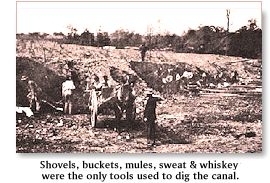
In 1834, a thousand men were working on the Wabash and
Erie, mostly westward of Fort Wayne
James Chute to Absalom Peters. Sept. 12, 1833. U. of
Notre Dame Archives
In the following year (1935) between one and two thousand
men labored between Fort Wayne and Huntington.
Old Towpaths. Alvin F, Harlow 1926 D. Appleton Co.
Work became general along the line of the canal in
Huntington County in the year 1834, large numbers of men being employed in its
construction. These men were paid off at Huntington at stated times, and a large part of
the money spent here, making times easy and money plenty, and the population and business
of the town increased very rapidly.
History of Huntington County. 1887
 A number of stone cutters, chiefly Irish, and many with
their families, have arrived here the past week from New York on their way to Lafayette to
work on the canal...They were engaged by G.M. Nash who advertised in the New York papers
and by bills posted...that he was authorized by Messrs. Moorehead & Co. of Lafayette
to engage them to work on the canal. Nash got $6.50 from each and gave them passage to
Toledo. From Toledo Moorehead & Co. would give them passage to Lafayette, where their
fares would be returned. A number of stone cutters, chiefly Irish, and many with
their families, have arrived here the past week from New York on their way to Lafayette to
work on the canal...They were engaged by G.M. Nash who advertised in the New York papers
and by bills posted...that he was authorized by Messrs. Moorehead & Co. of Lafayette
to engage them to work on the canal. Nash got $6.50 from each and gave them passage to
Toledo. From Toledo Moorehead & Co. would give them passage to Lafayette, where their
fares would be returned.
The Company denies all knowledge of Nash, and needs no
stone cutters since the locks are made of wood. These families are to be pitied. Induced
by high wages, now they have no money, and no jobs.
Fort Wayne Sentinel, August 27, 1842
A very attractive inducement to many Irish and German
immigrants was the offer of the Canal Trustees to sell 40, 80 or 160 acres of land at
favorable rates to canal construction laborers.
Indiana Documentary Journal, 1847 |